Top Enterprise Search Features That Improve Information Discovery
What Are Enterprise Search Features and Why Do They Matter?
Organizations manage information across documents, databases, applications, websites, and other content repositories. As the volume of information increases, employees can find it difficult to locate the right content quickly, particularly when information is spread across different systems. Effective Enterprise Search Features help address this challenge by making organizational information easier to discover, search, and access through a unified experience.
A capable enterprise search solution should do more than return results based on matching words. It should help users find relevant information, understand search intent, work with different content sources, and access results according to their permissions. 3RDi Search provides enterprise search capabilities designed to support information discovery across diverse content environments. In this blog, we explore the key Enterprise Search Features that organizations should consider when choosing a search solution for better accessibility, relevance, and user experience.
What Should You Look for in Search Platform Features?
When evaluating an enterprise search solution, organizations need to look beyond basic keyword matching. The right Search Platform Features should help users locate relevant information across different content sources while supporting accuracy, accessibility, security, and scalability. A well-designed platform should also be flexible enough to adapt as content volumes and business requirements change.
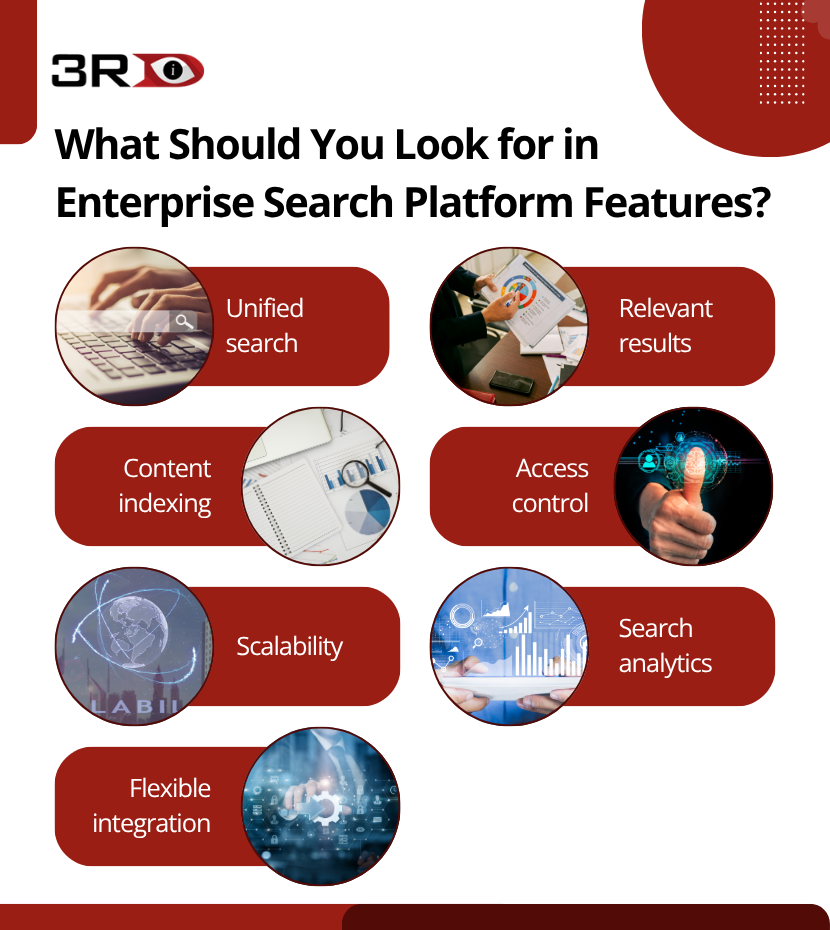
Key Search Platform Features to consider include:
- Unified search: Search across multiple content sources from a single interface.
- Relevant results: Prioritize useful results based on the user's search query and context.
- Content indexing: Organize information from different repositories so it can be discovered efficiently.
- Access control: Ensure users only see information they are authorized to access.
- Scalability: Support growing volumes of content and increasing search activity.
- Search analytics: Provide insights into search behaviour, popular queries, and unsuccessful searches.
- Flexible integration: Connect with different applications, repositories, and enterprise data sources.
3RDi Search brings together capabilities designed to help organizations search and discover information across diverse content environments, making these features important considerations when building an effective enterprise search experience.
How Does Search Software Improve Enterprise Information Discovery?
Choosing the right Search Software can significantly influence how easily employees find and use organizational information. Instead of requiring users to search through individual applications, folders, or repositories, enterprise search software can provide a centralized way to discover relevant content across connected sources. This can reduce the time spent looking for information and make existing organizational knowledge more accessible.
Effective Search Software should also support more than basic keyword matching. Features such as content indexing, relevance-based results, filtering, access controls, and search analytics can help users find useful information while maintaining appropriate content visibility. The ability to connect different data sources is equally important for organizations that manage information across multiple systems.
3RDi Search is designed to support enterprise information discovery across diverse content sources, helping organizations create a more accessible search experience. By combining relevant search capabilities with centralized access to organizational content, businesses can make information easier to locate and support more efficient day-to-day work.
How Do NLP and Analytics Enhance Enterprise Search?
Traditional search often depends on exact words entered by users, but employees may phrase the same request in different ways. NLP (Natural Language Processing) can help search systems interpret the meaning and context behind queries, making it easier to connect user intent with relevant content. This can improve the search experience when users use natural language, variations of terms, or more conversational queries.
Analytics adds another important layer by helping organizations understand how their search environment is being used. Search data can reveal frequently searched topics, popular queries, unsuccessful searches, and patterns in user behaviour. These insights can help teams identify content gaps, improve search relevance, and make informed decisions about future search improvements.
3RDi Search combines enterprise search capabilities with analytics-driven insights to help organizations understand search behaviour and improve information discovery. By using NLP and analytics as part of an enterprise search strategy, organizations can create a more responsive and user-focused search experience.
What Are the Top 3RDi Enterprise Search Software Features?
3RDi Search is designed to address the challenges organizations face when information is distributed across multiple repositories and users need more than basic keyword-based search. Its capabilities focus on helping organizations make enterprise information easier to discover while supporting different search requirements and content environments.
3RDi Search uses semantic search capabilities to help users find information based on meaning and context rather than relying only on exact keyword matches. This can make search more useful when different terms or phrases are used to express a similar requirement.
With NLP, 3RDi Search can interpret search queries in a more context-aware manner. This helps users interact with enterprise search using natural language and improves the ability to identify relevant information from large content collections.
3RDi Search provides analytics that can help organizations understand how users interact with search. By examining search behaviour, frequently used queries, and unsuccessful searches, organizations can identify opportunities to improve content discoverability and search relevance.
These capabilities help differentiate 3RDi Search from a basic keyword-based search solution by focusing on context, user intent, and measurable search behaviour.
Key Takeaways on Enterprise Search Features
Enterprise search is most effective when it goes beyond basic keyword matching and helps users discover relevant information across diverse content sources. Features such as unified search, content indexing, flexible integration, NLP, semantic search, and search analytics can help organizations improve information accessibility, understand search intent, and make better use of their existing knowledge.
With 3RDi Search, organizations can enhance information discovery through capabilities that focus on search context, natural language queries, semantic relevance, and user search behaviour. By selecting the right enterprise search features based on business and user requirements, organizations can create a more accessible and effective search experience while supporting productivity and informed decision-making.
Ready to improve information discovery across your organization? Explore 3RDi Search today and discover how its enterprise search capabilities can help your teams find relevant information more effectively.
In our next blog, we'll explore Enterprise Search for Healthcare and examine how enterprise search can help healthcare organizations improve information discovery, access relevant content, and manage information across diverse healthcare environments.
Key Questions About Enterprise Search Features
What are Enterprise Search Features? Enterprise Search Features are capabilities that help organizations search, discover, and access information across multiple content sources through a unified search experience.
What are the key Search Platform Features to consider? Key features include unified search, content indexing, relevant results, access controls, scalability, analytics, and integration with different enterprise content sources.
Does Search Software improve enterprise information discovery? Yes, absolutely. Search Software can help employees find relevant information across connected repositories without searching through individual systems separately, making organizational knowledge easier to access.
Does NLP improve enterprise search? Yes, it does. NLP helps search systems understand the meaning and context of user queries, allowing them to identify relevant information beyond exact keyword matches.
Does semantic search improve search relevance? Yes, absolutely. Semantic search considers the meaning and context behind a query, helping users discover relevant information even when the content uses different words or phrases.
Can Search Analytics help organizations improve search? Yes, absolutely. Search Analytics provides insights into search behaviour, frequently searched terms, unsuccessful queries, and content discovery patterns, helping organizations identify opportunities for improvement.
What are the top 3RDi Enterprise Search Software Features? The key 3RDi capabilities covered in this blog are Semantic Search, Natural Language Processing, and Search Analytics. Together, they support better search relevance, user intent understanding, and search performance insights.
Can 3RDi Search support enterprise information discovery? Yes, absolutely. 3RDi Search helps organizations discover information across diverse content environments while supporting capabilities such as semantic search, NLP, and search analytics.